
We only use AI for the basics. How do we get past that?
Most companies are stuck using AI to ask it questions. What it takes to get past the basics, from Gallup's research and one firm that did it.
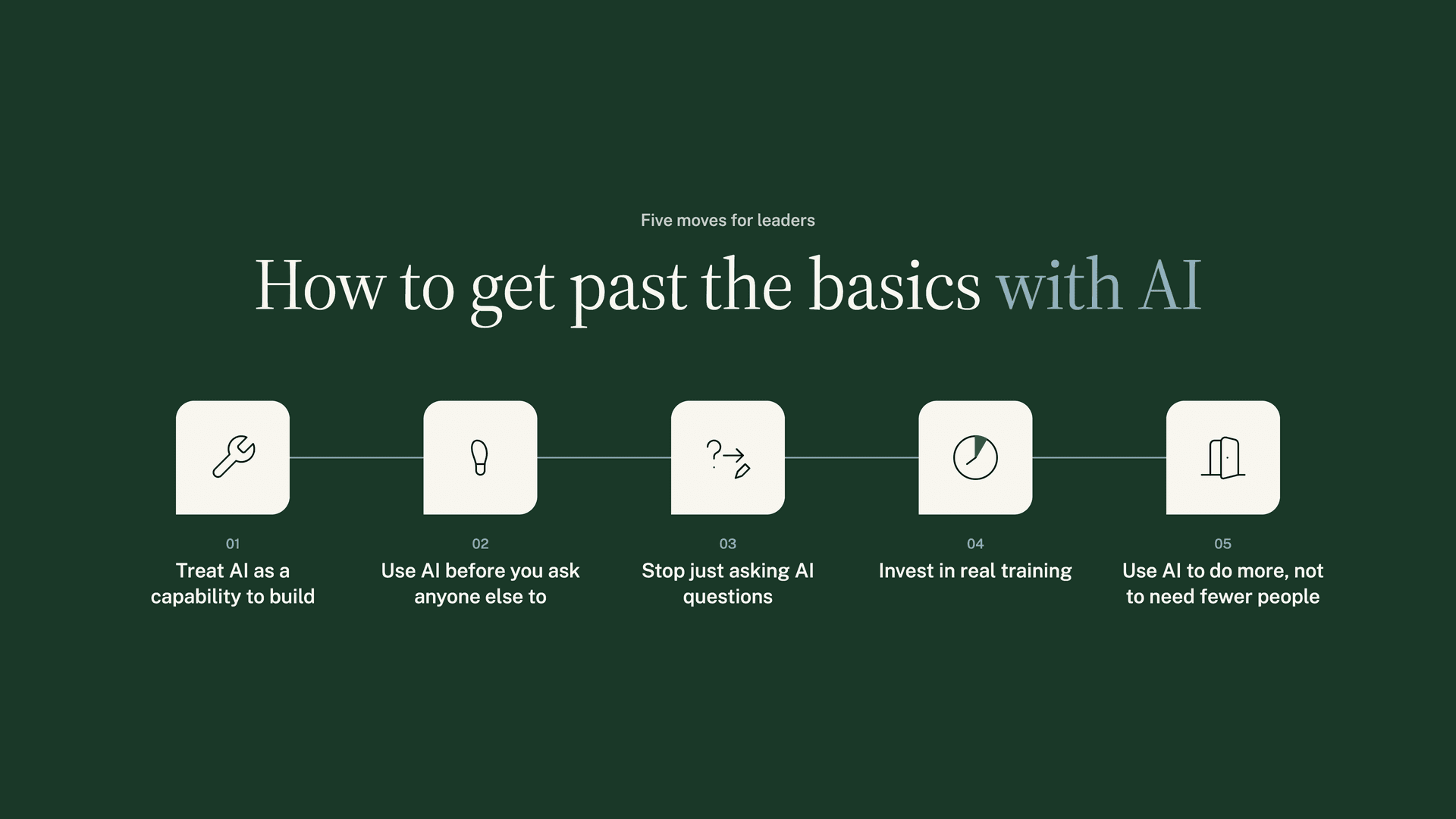
You get past the basics when your people stop asking AI questions and start building with it. Another tool won't get you there. Gallup's research shows what does: managers who back it, AI built into the real work, room to experiment, and clear rules. Every one of those is a leader's decision.
Let me guess where you are. The licenses are bought. People use them to clean up a spreadsheet, draft a post, soften an email they were nervous about sending. All real. All the basics. Gallup finds about half of U.S. employees use AI in their role, but only 28% use it weekly or more, and just 13% use it daily. I talk with leaders every day, and nearly every one of them feels behind. (Everyone can't be behind. That's not how behind works.)
Source: Gallup, Rising AI Adoption Spurs Workforce Changes, April 2026.
Why do so many companies get stuck at the basics?
The basics is asking. You type a question, get an answer, paste it somewhere. We call people at this stage Askers, and there's nothing wrong with it. But AI knows nothing about your business when you ask, so all it can give you is a generic answer. A Builder organizes information, context and memory (all better words than data) and hands AI an actual job. An Orchestrator redesigns whole workflows and holds the output to a standard. Same tools at every stage. What changes is the person.
Gallup's data shows what happens when people stay Askers. Among employees who use AI only now and then, 27% say they've tried it and don't find it useful in their role. Of course they don't. Ask AI a generic question and you get a generic answer. A generic answer rarely changes anyone's work. Give it a whole job, then bring your judgment.
Source: Gallup, AI in the Workplace: What Separates Adopters and Holdouts, April 2026. 23,717 U.S. employees.
Size doesn't get you past this, and neither does spending. I recently sat down with the AI team at a large defense contractor that has rolled out three different AI tools. Access is not their problem. But most of their people still use AI the way they use a search engine: a quick question, a summary, a cleaner paragraph. For most of the company, the work itself looks the same.
Why don't more tools fix it?
Because the gap isn't the AI tools. The gap is the capability to use them, and building that capability is on us as leaders. Most companies handed their people a tool and called it a rollout, without the training, time or coaching to turn it into a skill. It's a skill, not a subscription.
When Gallup asks people who have AI and don't use it why, the top answer (46%) is that they prefer to keep doing their work the way they do it now. Only 9% say they don't have access. Buying another tool solves the 9%. The tools will keep changing. Build the capability that doesn't.
Source: Gallup, AI in the Workplace: What Separates Adopters and Holdouts, April 2026. 23,717 U.S. employees.
How did one firm get past it?
Phil Lezar is a partner at Banbridge Capital, a private credit lender in Dallas that finances hotel construction. Not long ago, his firm was where you are. AI was, in his words, "really more of like a small productivity lift." Some deck work. Some modeling.
His breakthrough at our Senior Leader Intensive wasn't a tool. It was a habit. When he got stuck, he went to YouTube, Google or Reddit to find someone who had already solved it. In the room, I kept saying the same thing: just ask Claude. So he started screenshotting his problems and handing them back to the AI to fix. "The best agents are built by agents," he told me. "It literally would never have occurred to me before that."
That's the move from Asker to Builder, in one habit.
Today Banbridge's three partners run what Phil calls a fleet of four agents. If something is happening at the firm, one of those agents is touching it.
One agent assembles the document packages for their monthly construction draws. Over two months that meant thousands of documents, every one read, checked and put where it belonged. It saved 264 hours, or 33 eight-hour workdays. Another agent lives on their website: a developer can apply for a loan in about ten minutes, and a second agent turns the submission into a draft credit memo in roughly fifteen.
Notice where those agents live. Not in a separate AI project, but inside the work Banbridge already does every month. That turns out to matter more than almost anything else.
What do people get back when AI takes on that work?
They get the work only a person can do, with more time and better information to do it.
I know how "264 hours" can land. It can sound like a job going to a computer. But Phil did that work himself as an analyst, and he called it the worst: thousands of documents, any one of which can hurt a client if it's wrong, and the anxiety that comes with that. Nobody is built to read all of it with full attention. The agent is. And at Banbridge there was no analyst to replace. That work fell on three partners, on top of everything else.
Now the partners spend their time going over deals closely instead of assembling packages, and the credit decision stays human. They aren't removing the human from underwriting, Phil said, they're "multiplying that human." The rest of the time goes to new ideas, not just a faster version of the old work. Phil, who never would have called himself creative, now asks what the blue-sky version of a workflow looks like and goes to build it.
That's the difference between automating and augmenting. Automating with AI makes the old way faster. Augmenting moves people toward judgment, relationships and new ideas. If the best thing you can think to do with AI is cut people, that's a stunning lack of imagination.
What should a leader do?
You might be thinking that three partners is not your 2,000-person company. Fair. But Gallup's research across more than 23,000 U.S. employees points to the same four conditions at any size. Where they're in place, people use AI often and report it changing their work. Where they're missing, adoption stalls. Here's how I'd act on each, with one move before and one after.
Source: Gallup, AI in the Workplace: What Separates Adopters and Holdouts, April 2026. 23,717 U.S. employees.
Ask before you fix. Find out what's really holding your people back. When Gallup asks, the top answers are a preference for the way they work now, worries about privacy and security, and not seeing how AI fits their job. Which one is it on your team? Ask in a way people can answer honestly, and listen before you decide. People don't resist AI. They resist a future they can't see themselves in, and showing them one is your job.
Go first, and back your managers. Employees whose managers actively support their team's AI use are 8.7 times as likely to strongly agree AI has transformed how work gets done. Leaders already use AI more than anyone (67% use it frequently, compared with 46% of individual contributors), so the gap isn't your access. It's whether your people have seen you use it on real work. Build something with AI on your own work before you ask anyone else to. People follow where you've been, not where you point.
Source: Gallup, Global Indicator: Artificial Intelligence, as of May 2026.
Source: Gallup, AI in the Workplace: What Separates Adopters and Holdouts, April 2026. 23,717 U.S. employees.
Build it into the real work. This is the biggest gap in Gallup's data: 88% of people who say AI fits the systems and processes they already use are frequent users, compared with 55% of those who don't. So stop just asking AI and seeing what happens. Give it more to work with: how your business works, what good looks like, and a whole job to do, the way Phil's team does. Then bring your judgment. AI gives similar answers to everyone who asks a similar question, and that gets bland fast. The people who get the most from it know the strategy, know the standard, and hold the output to it.
Source: Gallup, AI in the Workplace: What Separates Adopters and Holdouts, April 2026. 23,717 U.S. employees.
Invest in training, and make room to fail. Where organizations support experimenting with AI, 72% of people use it frequently, compared with 44% where they don't. Learning AI in the five spare minutes between meetings isn't a plan. Learning AI takes real coaching on real work, protected time on the calendar, and room to get it wrong. Not a one-time session. Keep at it until they can do it without you. It's an investment in your people worth making.
Source: Gallup, AI in the Workplace: What Separates Adopters and Holdouts, April 2026. 23,717 U.S. employees.
Make the rules clear. Privacy and security worries hold back 38% of occasional users, and clear policies help: 68% of people who say their organization has clear AI guidelines use it frequently, compared with 47% of those who don't. Tell people what's safe to share, what's off limits, and who to ask. Nobody experiments freely while they're worried about breaking a rule they've never seen.
Source: Gallup, AI in the Workplace: What Separates Adopters and Holdouts, April 2026. 23,717 U.S. employees.
Then dream bigger. Let AI take the grind, and decide with your people what they'll do with the time they get back. Once your team has this capability, ask: What could we offer now that we couldn't before?
Phil's advice was shorter than mine. "No amount of thinking about AI is going to actually build anything." You have to go do it, and be okay getting punched in the nose a little along the way.
Phil joins me on December 2 for a live conversation with Joe Daly of Gallup and two other leaders who are changing how their work gets done. Register for the webinar.
Sources
Source: Gallup, Rising AI Adoption Spurs Workforce Changes, April 2026.
Source: Gallup, AI in the Workplace: What Separates Adopters and Holdouts, April 2026. 23,717 U.S. employees.
Source: Gallup, Global Indicator: Artificial Intelligence, as of May 2026.
Related
What is the AI adoption gap, and how do you close it?
The AI adoption gap is why AI tools haven't changed how work gets done. Why Gallup and Silent Partners built a joint venture to close it.
We rolled out AI tools. Why isn't anything changing?
Most AI rollouts give people new tools and leave the work the same. Why that happens, and three moves a leader can make first.
Gallup on what separates AI adopters from holdouts
Gallup finds the split is not access to the tools. Our read on what that means for sequencing.
